
A plumbing company website has a very different job from a portfolio site, a blog, or a general corporate website.
Most people do not visit a plumber’s website because they want to browse for fun. They usually have a problem.
A pipe is leaking. A drain is blocked. A water heater has stopped working. A toilet is overflowing. A landlord needs repairs completed quickly. A homeowner wants an estimate before replacing old plumbing.
That means a plumbing website needs to help visitors answer a few questions almost immediately:
- Can this company solve my problem?
- Do they serve my area?
- Can I trust them?
- How quickly can I contact them?
- What happens after I request help?
If a website makes those answers difficult to find, even a good plumbing company can lose leads.
A strong plumbing website should therefore be built around clarity, trust, local visibility, and fast action. It does not need complicated animations or a large number of pages. It needs the right information in the right places.
This guide explains what a plumbing company website should include and why each part matters.
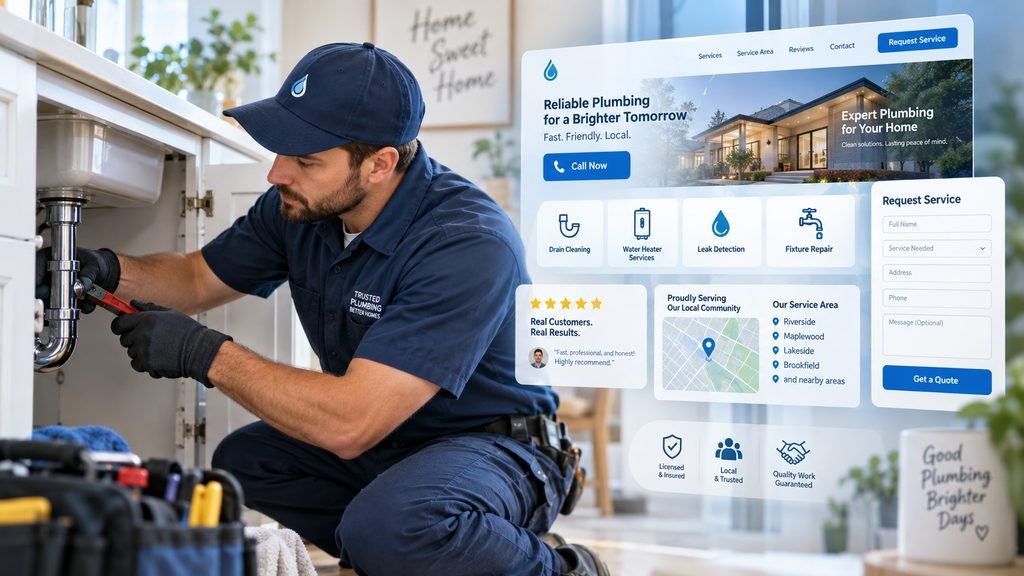
1. A Clear Homepage That Explains the Business Immediately
The homepage should tell visitors what the company does within a few seconds.
A common mistake is using a large headline that sounds impressive but says very little.
For example:
Quality You Can Trust
That sounds positive, but it does not tell the visitor whether the company handles drain cleaning, emergency repairs, water heaters, commercial plumbing, or another service.
A more useful homepage headline might be:
Residential and Commercial Plumbing Services in [Service Area]
Or:
Plumbing Repairs, Drain Cleaning, and Water Heater Services in [City]
The exact wording can vary, but the visitor should understand three things quickly:
- What the company does.
- Where it works.
- What action the visitor should take next.
The homepage should also make the primary call to action obvious.
For most plumbing companies, that action will usually be something like:
- Call Now
- Request Service
- Get an Estimate
- Schedule a Visit
- Request Emergency Help
The best choice depends on how the business actually handles incoming work.
The website should match the company’s real process rather than forcing visitors into a complicated online system that the business does not use.
2. Prominent Phone and Contact Options
Plumbing is one of the industries where phone calls can still be extremely important.
Someone dealing with a major leak may not want to fill out a long form and wait several hours for a response.
The phone number should therefore be easy to find.
Common locations include:
- The website header
- The homepage hero section
- The mobile navigation
- Service pages
- The contact page
- The footer
On mobile devices, the phone number should normally be clickable.
Visitors should not have to copy the number manually.
However, phone calls should not be the only contact method.
Some customers prefer written communication, especially when asking for estimates, describing a non-urgent issue, or contacting the company outside business hours.
A plumbing website can therefore offer several clear options:
Call for urgent service
Request service online
Send a message for non-urgent questions
This gives customers flexibility without making the contact process confusing.
3. A Simple Service Request Form
A plumbing company does not usually need a complicated twenty-field inquiry form.
Every extra field creates another reason for a visitor to stop.
A basic service request form can often collect:
- Name
- Phone number
- Service address or ZIP/postal code
- Type of plumbing problem
- Short message
- Preferred contact method
Some companies may also allow customers to upload photos.
This can be useful when a homeowner wants to show a damaged fixture, leaking pipe, water heater, or visible plumbing problem.
However, photo upload should only be added if the company will actually review those images.
Forms should also explain what happens after submission.
For example:
Submit your request and our team will contact you to confirm the details and availability.
That is much better than a button that simply says “Submit.”
Visitors want to know what comes next.
4. Individual Pages for Important Plumbing Services
One page listing every service is usually not enough for a serious local plumbing business.
The company’s most important services should normally have dedicated pages.
Possible examples include:
- Emergency Plumbing
- Drain Cleaning
- Leak Detection
- Pipe Repair
- Water Heater Repair
- Water Heater Installation
- Tankless Water Heaters
- Toilet Repair
- Faucet Repair
- Sewer Line Repair
- Sewer Camera Inspection
- Garbage Disposal Repair
- Sump Pump Services
- Repiping
- Commercial Plumbing
A company does not need to create a page for every tiny task it has ever completed.
The goal is to create useful pages for services that customers actively search for and that matter commercially to the business.
A strong service page should explain:
- What the service is
- Common problems the company handles
- Signs that a customer may need the service
- What the service process usually looks like
- Whether the company offers repair, replacement, inspection, or installation
- Which areas the company serves
- How to request help
The page should be written for customers, not for plumbers.
Too much technical terminology can make the page harder to understand.
5. A Dedicated Emergency Plumbing Section
If the company provides emergency plumbing, the website should treat it as a separate customer journey.
Emergency visitors behave differently from someone researching a future bathroom renovation.
They are more likely to scan the page quickly and look for immediate reassurance.
An emergency plumbing page should clearly explain:
- Whether emergency service is actually available
- The hours when emergency calls are accepted
- The areas covered
- What types of emergencies are handled
- The fastest way to contact the company
- What customers should do while waiting, when appropriate
Do not advertise “24/7 emergency plumbing” unless the company genuinely provides it.
A website should never create expectations the business cannot meet.
If emergency availability is limited, say so clearly.
Trust is more valuable than aggressive marketing claims.
6. Clear Service Area Information
Local service businesses need to make geography obvious.
A visitor should not have to call just to ask whether the company serves their neighborhood.
The website can include a dedicated service area page with:
- Primary city
- Nearby cities
- Counties or districts
- Neighborhoods
- ZIP/postal codes, where useful
The homepage and service pages can also mention the core service region naturally.
For example:
Serving homeowners and businesses throughout [City], [Nearby City], and surrounding areas.
This helps customers and also gives search engines better context about where the company operates.
Avoid creating dozens or hundreds of nearly identical location pages with only the city name changed.
Useful local pages should contain information that genuinely helps customers in that area.
7. Trust Signals That Reduce Customer Anxiety
Inviting a plumber into a home or commercial property requires trust.
The website should make that trust easier to establish.
Useful trust signals may include:
Business experience
If the company has been operating for many years, mention it.
Licensing information
If licensing is required and relevant in the company’s location, show the appropriate information clearly.
Insurance
If the business is properly insured and this matters to customers in the market, mention it accurately.
Certifications
Relevant manufacturer certifications or trade qualifications can help, but only if they are current and legitimate.
Real team information
Showing real technicians, owners, or staff can make a local service business feel much more credible than using generic stock photography.
Real customer reviews
Reviews are especially important for home services because customers often compare several local companies before calling.
Memberships or affiliations
Industry organizations can help establish credibility if they are meaningful and current.
The website should not overwhelm visitors with badges.
A few relevant trust signals are more convincing than a wall of logos with no explanation.
8. Customer Reviews and Testimonials
Reviews often influence which plumber a customer contacts.
The website should therefore make good use of genuine customer feedback.
Useful places for reviews include:
- Homepage
- Individual service pages
- Location pages
- Dedicated reviews page
Short reviews are often easier to scan than very long testimonials.
When possible, reviews should sound specific.
For example:
They arrived quickly, found the leak behind the wall, explained the repair clearly, and finished the work the same afternoon.
That is more useful than:
Great company. Highly recommended.
The website can also link to the company’s major third-party review profiles where appropriate.
Do not invent testimonials or rewrite customer reviews so aggressively that they no longer reflect what the customer actually said.
9. Real Project Photos
Plumbing companies have an advantage that many businesses overlook: their work naturally creates visual proof.
Useful photos might show:
- Water heater installations
- Repiping projects
- Pipe repairs
- Commercial plumbing work
- Fixture replacements
- Sewer equipment
- Before-and-after repairs
- Team members on actual jobs
Real photos help prove that the business does what the website claims.
They also make the website look more distinctive.
Many plumbing websites use the same generic stock images of sinks, tools, and smiling technicians.
A smaller collection of authentic project images can often create more trust.
Before publishing job-site photos, companies should make sure they are not exposing customer addresses, personal information, license plates, private documents, or other unnecessary identifying details.
10. An About Page That Feels Local and Real
The About page should not be filled with generic statements about “quality, integrity, and excellence.”
Those words are fine, but almost every service business says the same thing.
A more useful About page explains:
- How the company started
- Who runs it
- How long it has served the area
- What kind of plumbing work it focuses on
- What customers can expect
- What makes its service process different
- Which communities it serves
For a family-owned or locally operated plumbing company, this page can be especially valuable.
Customers often prefer to know who they are dealing with.
Real information builds more trust than corporate-sounding filler.
11. A Mobile-First Experience
A large percentage of plumbing searches happen on phones.
This is especially true for urgent problems.
A website that looks good on desktop but is frustrating on mobile can lose leads quickly.
The mobile version should make sure that:
- The phone number is easy to tap
- Contact buttons are large enough
- Text is readable
- Menus are simple
- Forms are easy to complete
- Pages load quickly
- Important information is not buried
- Pop-ups do not block the entire screen
A customer standing next to a leaking sink is unlikely to spend five minutes fighting with a bad mobile menu.
Mobile usability is not a decorative feature. For plumbing businesses, it is part of the sales process.
12. Fast Loading Pages
Speed matters because service customers are often impatient.
Large uncompressed images, excessive animation, too many scripts, and overloaded plugins can slow down a site.
A plumbing website usually does not need a visually heavy design.
Good performance often comes from keeping the website simple:
- Properly sized images
- Modern image formats where appropriate
- Reliable hosting
- Reasonable use of plugins
- Lightweight page layouts
- Caching
- Regular maintenance
Speed is especially important for mobile users on weaker connections.
A simple fast website can outperform a visually impressive but sluggish one.
13. Local SEO Foundations
A plumbing website should be designed so search engines can understand what the company does and where it operates.
Basic local SEO foundations include:
- Clear business name
- Consistent address information where appropriate
- Correct phone number
- Service areas
- Individual service pages
- Useful page titles
- Descriptive headings
- Logical internal links
- Google Business Profile integration
- Local reviews
- Mobile performance
- Structured contact information
The site should also avoid keyword stuffing.
A sentence such as:
Looking for the best plumber in Austin Texas plumbing services Austin emergency plumber Austin?
does not help real customers.
Search pages should read naturally.
A better approach is to create genuinely useful pages about the company’s services and locations.
14. Google Business Profile Integration
For a local plumbing business, the website and Google Business Profile should support each other.
The website can provide the authoritative information customers need, while the business profile can help customers discover the company through local search and Maps.
Important information should be consistent between them:
- Business name
- Main phone number
- Website
- Service category
- Hours
- Address or service-area setup
- Core services
A website link should lead to a useful page, not a broken landing page or outdated homepage.
If the company operates from a service area rather than a customer-facing office, the business should follow Google’s current service-area business guidance instead of publishing misleading address information.
15. Frequently Asked Questions
An FAQ section can answer questions that customers repeatedly ask before booking.
Examples include:
Do you offer emergency plumbing?
What areas do you serve?
Do you repair and install water heaters?
Can you provide an estimate before work begins?
Do you work on commercial properties?
What should I do if a pipe bursts?
Can I send photos of the problem?
What payment methods do you accept?
Do you guarantee your work?
Only include answers that match the company’s actual policies.
FAQs can appear on individual service pages instead of being placed into one giant site-wide FAQ.
A water heater page should answer water heater questions. A drain cleaning page should answer drain questions.
This keeps information more relevant.
16. Transparent Service Process
Customers often feel uncertain about what happens after they contact a contractor.
A simple “How It Works” section can reduce that uncertainty.
For example:
1. Request Service
Call or submit the online form.
2. Confirm the Problem
The company gathers the basic details and confirms availability.
3. Technician Visit
A technician inspects the plumbing issue.
4. Review the Recommended Work
The customer receives an explanation of the problem and recommended next steps.
5. Complete the Work
Approved repairs or installation are completed.
The exact steps should reflect the company’s actual workflow.
A transparent process helps customers know what to expect and can reduce unnecessary questions.
17. Pricing Information Where Appropriate
Plumbing companies handle pricing in different ways.
Some services may have predictable rates, while others depend heavily on diagnosis, materials, access, property conditions, and labor.
The website does not need to publish fixed prices if the company cannot accurately quote work that way.
However, it should explain how pricing works.
For example:
Pricing depends on the specific plumbing issue and the work required. After inspecting the problem, we explain the recommended work and pricing before proceeding.
This is more reassuring than saying nothing.
If the company charges diagnostic fees, call-out fees, emergency fees, or other standard charges, those should be communicated clearly when appropriate.
Transparency reduces friction.
18. Commercial Plumbing Information if the Company Serves Businesses
A company that works with commercial properties should usually separate that offering from residential plumbing.
Business customers may have different concerns, including:
- Response time
- Preventive maintenance
- Multiple locations
- Property management
- Documentation
- Scheduling outside business hours
- Compliance requirements
- Ongoing service relationships
A commercial plumbing page can explain which types of properties the company handles.
Examples might include:
- Restaurants
- Offices
- Retail stores
- Apartment buildings
- Warehouses
- Schools
- Property management portfolios
Do not simply copy the residential page and change the word “homeowner” to “business.”
Commercial customers have different needs.
19. Clear Calls to Action Throughout the Website
Every major page should make the next step obvious.
A visitor should never reach the bottom of a service page and wonder what to do.
Good calls to action might include:
- Request Plumbing Service
- Call for Service
- Request an Estimate
- Schedule an Inspection
- Contact Our Team
There should usually be one primary action rather than five competing buttons.
For example, if the company prefers customers to call for urgent issues and use a form for normal requests, the website can make that distinction clear.
The goal is not to put a button every few inches.
The goal is to provide the right action when the visitor is ready.
20. A Useful Contact Page
The Contact page should include more than a form.
Useful information may include:
- Phone number
- Email or written inquiry method
- Business hours
- Emergency service information
- Service area
- Address if customers actually visit that location
- Contact form
- Expected response process
If the company does not operate a public walk-in office, do not design the page in a way that encourages customers to arrive there unexpectedly.
The website should reflect how the business really works.
21. Privacy, Security, and Basic Website Protection
Even a simple plumbing website collects information.
Contact forms may include:
- Names
- Email addresses
- Phone numbers
- Property addresses
- Messages
- Photos
That means basic website security matters.
The site should use HTTPS and keep its website software, plugins, themes, forms, and integrations updated.
Spam protection should also be considered.
A broken or compromised contact form can quietly cost a plumbing company leads without anyone noticing.
The business should also have an appropriate privacy notice based on what information it collects and the laws that apply to its location.
22. Reliable Form and Lead Tracking
A plumbing company should know whether its website is actually generating inquiries.
At minimum, the business should regularly test:
- Contact forms
- Quote forms
- Click-to-call buttons
- Email notifications
- Confirmation messages
- Mobile form submission
One surprisingly common problem is a form that looks normal but stops delivering email.
The company may think nobody is requesting service when the real problem is technical.
Important forms should therefore be tested after:
- Website updates
- Plugin updates
- Hosting changes
- Email configuration changes
- Form changes
For businesses that rely heavily on web inquiries, storing form submissions safely inside the website or CRM can provide a backup if an email notification fails.
23. Analytics Without Making the Website Complicated
Basic analytics can help a plumbing business understand how people use the website.
Useful questions include:
- Which service pages receive traffic?
- Which pages generate calls or forms?
- Which locations bring visitors?
- Are people mostly using phones or desktops?
- Which marketing campaigns generate leads?
- Where do visitors leave the website?
The company does not need dozens of dashboards.
The goal is to identify useful business information.
For example, if the drain cleaning page receives traffic but almost nobody contacts the company, that page may need clearer information or a stronger contact path.
24. Ongoing Website Maintenance
A plumbing website should not be launched and forgotten for five years.
Over time, information changes.
The company may:
- Add services
- Stop offering services
- Hire new technicians
- Expand into new areas
- Change business hours
- Get new certifications
- Change phone numbers
- Update emergency availability
- Add new reviews
- Change its service process
Old information can damage trust.
The website should therefore be reviewed periodically.
Basic maintenance should also include:
- Software updates
- Backups
- Security monitoring
- Broken link checks
- Form testing
- Performance checks
- Mobile testing
- Removing outdated content
A modest but well-maintained website is usually better than a large site full of outdated pages.
Recommended Plumbing Website Structure
A small or mid-sized plumbing company does not necessarily need a huge website.
A practical structure might look like this:
| Page | Purpose |
|---|---|
| Home | Explain the company, location, major services, trust signals, and primary contact action |
| Services | Overview of all major plumbing services |
| Individual Service Pages | Explain important services in detail |
| Emergency Plumbing | Give urgent visitors a fast path to contact |
| Commercial Plumbing | Explain business/property services if offered |
| Service Areas | Clearly show where the company works |
| About | Build trust with real company information |
| Reviews | Present genuine customer feedback |
| Contact / Request Service | Make contacting the business simple |
| FAQ | Answer common customer questions where useful |
| Privacy Policy | Explain relevant data collection and privacy practices |
The exact structure depends on the business.
A one-person local plumber does not need the same site architecture as a multi-location plumbing company.
What a Plumbing Website Does Not Need
Adding more features does not automatically create a better website.
Many plumbing companies can avoid:
Complicated animations
They often slow the site down without helping customers.
Huge image sliders
Visitors usually need service information, not a rotating presentation.
Long introductions before the services
People should not need to scroll through company philosophy before discovering whether drain cleaning is available.
Excessive stock photography
Real work and real people are usually more persuasive.
Dozens of weak location pages
Thin pages created only for search engines can make the site feel repetitive and low quality.
Complicated customer accounts
Unless the company provides recurring services that genuinely benefit from a portal, most customers simply want to request service.
Unnecessary online booking systems
Online scheduling can be useful, but only if it matches the company’s dispatch process.
If every booking still requires a manual phone call to reorganize the schedule, a simple request form may work better.
Plumbing Company Website Checklist
Before considering the website complete, a plumbing company should be able to answer yes to most of these questions:
| Question | Check |
|---|---|
| Can a visitor immediately understand what plumbing services the company provides? | ☐ |
| Is the main service area obvious? | ☐ |
| Is the phone number easy to find and tap on mobile? | ☐ |
| Is there a simple way to request service online? | ☐ |
| Do the most important services have their own useful pages? | ☐ |
| Is emergency availability explained accurately? | ☐ |
| Are real reviews visible? | ☐ |
| Are licenses, certifications, or insurance claims accurate and current where relevant? | ☐ |
| Does the website contain real company information? | ☐ |
| Does it work well on mobile? | ☐ |
| Do pages load quickly? | ☐ |
| Are service areas clearly explained? | ☐ |
| Are calls to action easy to understand? | ☐ |
| Does the contact form work correctly? | ☐ |
| Are form submissions and notifications tested? | ☐ |
| Is the website regularly updated and backed up? | ☐ |
Final Thoughts
A plumbing company website does not need to be complicated.
It needs to help the right customer quickly understand:
what the company does, where it works, why it can be trusted, and how to request help.
The strongest plumbing websites usually combine clear service information, strong local trust signals, useful service pages, real customer reviews, simple contact options, good mobile performance, and a website that is maintained after launch.
The design matters, but design should support the customer journey rather than distract from it.
A person dealing with a plumbing problem is rarely looking for the most creative website in the market.
They are looking for a company that appears capable, trustworthy, local, and easy to contact.
That is what the website should make obvious.
Related reading: small business website essentials, what belongs on a small business homepage, and small business website costs.