
If you are researching small business website cost, one of the first questions is usually simple: how much should a professional website actually cost for the kind of business you run?
How much should it actually cost?
Unfortunately, website pricing can be confusing. One provider may quote a few hundred dollars, another may quote several thousand, and a larger agency may quote considerably more for what appears to be the same thing.
The reason is that a “business website” is not a single standardized product.
A simple website for a local service company has very different requirements from an online store, booking platform, membership website, customer portal, or custom web application.
For most small businesses, the useful question is not:
“What is the average price of a website?”
It is:
“What does my business actually need, and what should I expect to pay for that level of work?”
This guide explains what affects website cost, what you are really paying for, and how to avoid paying for either too little or far more than your business needs.
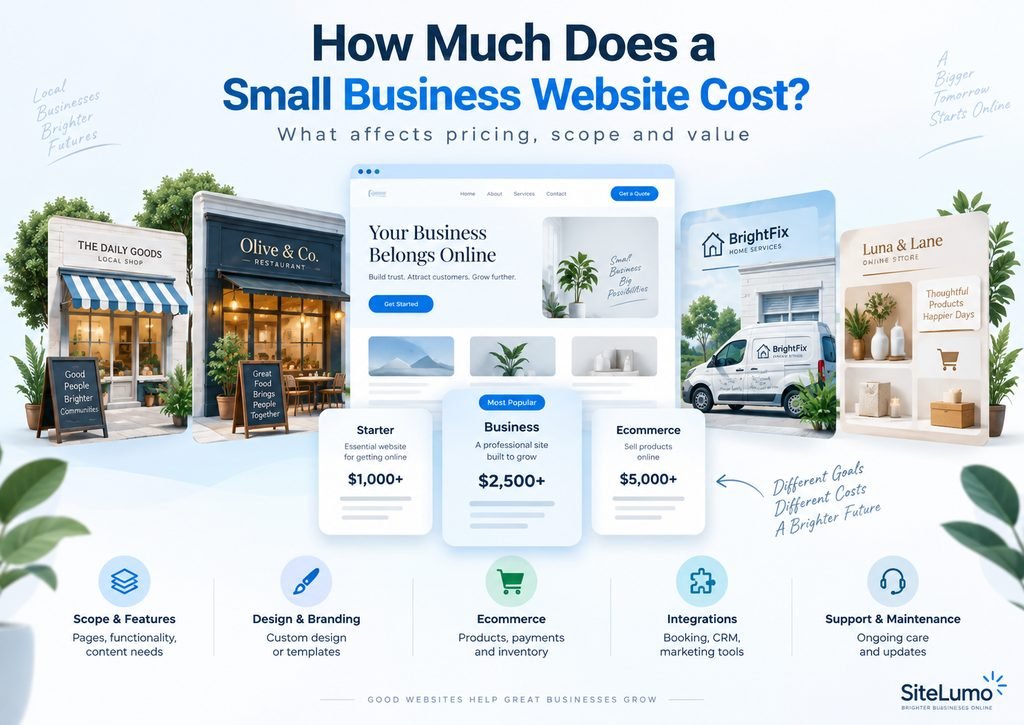
Small Business Website Cost: The Short Answer
A small business website can range from a relatively inexpensive template-based build to a project costing many thousands of dollars.
Professional website pricing varies widely because providers may be offering very different levels of design, customization, content work, ecommerce functionality, integrations, testing, project management, and ongoing support.
Current website budgeting guidance from Clutch shows how wide that range can be: professionally built small-business websites can start in the hundreds or low thousands and rise significantly as customization and functionality increase.
For a typical small business, the biggest price differences usually come from:
- the type of website
- the amount of custom design required
- the functionality needed
- ecommerce requirements
- integrations with other systems
- who provides the content
- how much testing and project management is included
- what happens after launch
Understanding these factors is much more useful than comparing prices alone.
1. What Type of Website Do You Need?
This is usually the biggest starting point.
One-Page Business Website
A one-page website can work well for a simple business that mainly needs:
- a professional online presence
- a clear explanation of its services
- contact information
- a quote or enquiry form
- trust signals
- basic company information
Examples may include a freelancer, consultant, tradesperson, small local service business, or a business launching for the first time.
Because the project is smaller, it will usually cost less than a complete multi-page website.
But a one-page website should not simply be the cheapest option.
If customers need detailed service information, multiple locations, case studies, individual product pages, extensive FAQs or significant search visibility, a larger site may make more sense.
Multi-Page Business Website
This is the most common choice for an established small business.
A typical structure might include:
- Home
- About
- Services
- individual service pages
- Contact
- FAQs
- Portfolio or Projects
- Blog or Resources
- legal pages
The cost increases because more work is required across design, content structure, navigation, responsive layouts and testing.
However, page count alone is not always a good way to price a website.
A 15-page informational website can sometimes be simpler than a five-page website containing complex booking, account or integration functionality.
The overall scope matters more than the raw number of pages.
Ecommerce Website
An online store normally costs more because it is not simply displaying information.
It also has to handle business processes such as:
- products
- product variations
- shopping cart
- checkout
- payments
- taxes
- shipping
- customer emails
- order management
- inventory
- refunds
- discount codes
- account management
Some stores also require subscriptions, international currencies, wholesale pricing, advanced shipping rules or connections to external inventory and accounting systems.
That additional functionality means more configuration, testing and ongoing responsibility.
Custom Website or Web Application
If customers need to log in, manage data, create records, interact with dashboards, use custom workflows or perform functions that ordinary website platforms do not provide, the project may no longer be a normal website.
It may actually be a web application or custom software project.
That is an important distinction.
Trying to force custom software requirements into a low-cost website package usually creates problems later.
2. Template-Based vs Custom Design
Two websites can contain exactly the same pages and still have very different costs.
The difference may be in how they are designed.
Template-Based Approach
A professionally selected and customized template can be a very sensible option for many small businesses.
It can reduce:
- design time
- development time
- project cost
- unnecessary technical complexity
Using a mature design system or framework is not automatically a compromise.
For a business that mainly needs a professional, reliable website, starting from a proven foundation can often be more practical than paying someone to reinvent every component from scratch.
The important question is whether the final result still reflects your business rather than looking like an unchanged generic template.
Fully Custom Design
Custom design becomes more valuable when:
- the brand has unusual requirements
- the website needs a distinctive visual identity
- the user journey is complex
- standard layouts do not fit the business
- the website is central to the company’s competitive advantage
More original design normally requires more planning, design work, revisions and implementation.
That increases the cost.
For many small businesses, however, full custom design is not always necessary.
The best solution is the one that solves the business problem without adding complexity purely for the sake of being custom.
3. Functionality Changes the Price Quickly
A brochure-style website is relatively straightforward.
Once the website has to do something, the scope can change substantially.
Examples include:
- appointment booking
- customer accounts
- membership areas
- online payments
- quote calculators
- product filtering
- multilingual functionality
- subscriptions
- CRM integration
- live chat
- AI customer support
- external API integrations
- customer portals
- advanced forms
- automated workflows
This is why two businesses asking for a “10-page website” may receive completely different quotes.
One may simply need ten informational pages.
The other may require payments, CRM synchronization, automated emails and customer accounts.
Those are not equivalent projects.
4. Content Can Be a Hidden Cost
A website still needs:
- headlines
- service descriptions
- company information
- calls to action
- images
- product information
- FAQs
Someone has to create them.
Before accepting a quote, check whether you are expected to provide all content yourself.
Some providers only build the website after receiving finished text and images.
Others help organize existing material.
Others include copywriting, photography, illustration or content strategy.
None of these approaches is necessarily wrong.
The problem occurs when the client expects one thing and the provider has priced another.
Ask specifically:
“What content do I need to provide before the project starts?”
5. Mobile Design Should Not Be an Optional Extra
A professional business website should work properly across different screen sizes.
That includes:
- desktop
- tablet
- mobile
Responsive design involves more than shrinking the desktop page.
Navigation, buttons, forms, images, text spacing and layouts often need to behave differently on smaller screens.
A quote that appears unusually inexpensive may deserve closer inspection if mobile behavior has not been properly considered.
This is particularly important for local service businesses because many potential customers will visit from a phone when they are ready to call, request a quote or find a location.
6. Integrations Can Change a Simple Website Into a Larger Project
Many businesses already use software such as:
- CRM systems
- email marketing platforms
- booking tools
- accounting software
- payment providers
- inventory systems
- help desks
- automation platforms
Sometimes the best website solution is not to recreate those functions.
It is to connect the website to systems that already work.
For example:
Website form → CRM → automated confirmation → sales follow-up
may be much more sensible than developing an entire CRM inside the website.
This is also why a provider should understand the existing software you use before recommending custom development.
For mature business functions, integrating a proven system can be cheaper, faster and easier to maintain than building everything from scratch.
7. Who Builds the Website Matters
Website pricing is also affected by the type of provider.
DIY Website Builder
This has the lowest upfront professional cost because you are doing most of the work yourself.
However, your own time becomes part of the real cost.
DIY may work if:
- your requirements are very simple
- you enjoy working with websites
- time is not a major concern
- you are comfortable handling ongoing changes
For a business owner who does not want to learn web design, DIY can quickly become less attractive.
Freelancer
A freelancer may offer:
- lower overhead
- direct communication
- competitive pricing
- a personalized working relationship
The important questions are availability, technical coverage and what happens if the freelancer becomes unavailable.
Small Studio
A small web studio can sit between an individual freelancer and a larger agency.
It may provide professional design and development without the overhead of a large team.
This can be a good fit for small businesses that want the work handled professionally but do not require a large agency structure.
Large Agency
Agencies may provide teams covering:
- strategy
- UX
- design
- development
- copywriting
- SEO
- project management
- analytics
- marketing
For larger or more complex organizations, that can be valuable.
For a straightforward small-business website, however, you may be paying for capabilities and management layers that you do not actually require.
8. Cheap Websites Can Become Expensive Later
The lowest quote is not automatically the best value.
A website may become expensive later if:
- you cannot easily edit it
- the provider controls your domain
- you cannot access the hosting account
- basic functionality requires constant paid changes
- the site depends on abandoned software
- mobile layouts are poor
- important forms do not work
- there are security problems
- nobody maintains it
- moving to another provider becomes difficult
Before comparing quotes, ask what happens after launch.
A slightly higher initial price can sometimes be cheaper over several years if the website is easier to own, maintain and update.
9. Expensive Does Not Automatically Mean Better
The opposite is also true.
A small business does not need enterprise infrastructure simply because it sounds impressive.
You may not need:
- a fully custom CMS
- custom authentication
- a custom booking platform
- a custom CRM
- a custom ecommerce engine
- bespoke functionality that mature software already provides
A good provider should sometimes tell you:
“You do not need to build this.”
Using a mature platform, plugin, service or integration can be the better engineering and business decision.
The goal should be to spend money where customization actually creates value.
10. What Should Be Included in the Quote?
Before comparing prices, make sure you are comparing the same scope.
A useful website proposal should make it clear what is included in areas such as:
Project scope
What type of website is being built?
Pages
Which pages or content types are included?
Design
Is it template-based, customized or fully custom?
Mobile
Is responsive design included?
Content
Who supplies text, images and product information?
Forms
What enquiry, contact or quote functionality is included?
Ecommerce
If applicable, what store functionality is included?
Integrations
Will the website connect to other systems?
Revisions
How are design changes handled?
Testing
What is tested before launch?
Launch
Who handles deployment and configuration?
Ownership
Who owns the website, domain and accounts?
Support
What happens after the website goes live?
Without this information, comparing two prices can be misleading.
11. Do Not Choose a Website Based on Page Count Alone
Many businesses start by asking:
“How much for five pages?”
Page count can matter, but it is rarely the most important factor.
Consider two websites:
Website A
- Home
- About
- Services
- Contact
- FAQ
No unusual functionality.
Website B
- Home
- Products
- Account
- Dashboard
- Checkout
Both have five major pages.
But Website B may involve authentication, databases, payments, permissions and custom workflows.
The scope is completely different.
A better quote should be based on what the website must accomplish rather than simply how many URLs it contains.
12. Think About the Website as a Business Asset
A website should not be judged only by what it costs to create.
Consider what you need it to do.
For example:
- establish credibility
- explain your services
- generate enquiries
- accept orders
- take bookings
- support existing customers
- reduce repetitive questions
- give customers somewhere reliable to find your business
For many small businesses, the website is one of the few digital assets the business actually controls.
Social platforms, marketplace profiles and directory listings can be useful, but they belong to someone else’s platform.
Your own website gives your business a permanent destination that you control.
That changes the way the investment should be evaluated.
So, How Much Should You Spend?
There is no single correct budget for every small business.
Instead, match the investment to the job the website needs to perform.
A simple business that mainly needs credibility and enquiries may only require a straightforward professional website.
A company that needs ecommerce, booking, customer accounts, integrations or custom workflows should expect a larger project.
Before deciding how much to spend, answer these questions:
- What must the website accomplish?
- What functionality is genuinely necessary?
- What existing software can be reused or integrated?
- Who will provide the content?
- Who will maintain the website after launch?
- Do you need a simple business website, an online store or actually a software application?
- What will you own when the project is finished?
Once those answers are clear, comparing website quotes becomes much easier.
Final Thoughts
The cost of a small business website is not determined by a single industry rate.
It is determined by the combination of:
scope + design + functionality + integrations + content + support.
The cheapest approach may be enough for a very simple business.
A more complex company may need a significantly larger investment.
The important thing is to avoid paying for unnecessary complexity while also avoiding a website that cannot support what your business actually needs.
If you are planning a new business website and want a clear scope before committing to a project, you can review the available Website services or request a quote based on your actual requirements.
Related reading: professional business website costs, setting a realistic website scope, and small business website essentials.
If you are ready to turn that budget into a project scope, review SiteLumo’s Business Websites service or request a quote.