
A business website can do many things.
It can introduce your company, explain services, answer questions, generate leads, sell products, book appointments, collect email subscribers, support customers, or help people visit a physical location.
The problem begins when you try to make all of those things equally important.
A website without a clear priority often becomes crowded with competing messages and buttons. Visitors may understand what the business does but still be unsure about what they should do next.
That is why one of the most useful decisions you can make before designing a website is to choose its primary goal.
Your primary website goal is the most important result you want the website to help produce.
It does not mean the website can only do one thing. It simply gives the rest of the site a clear priority.
This guide will show you how to choose that goal and turn it into something practical enough to guide your website structure, content, and calls to action.
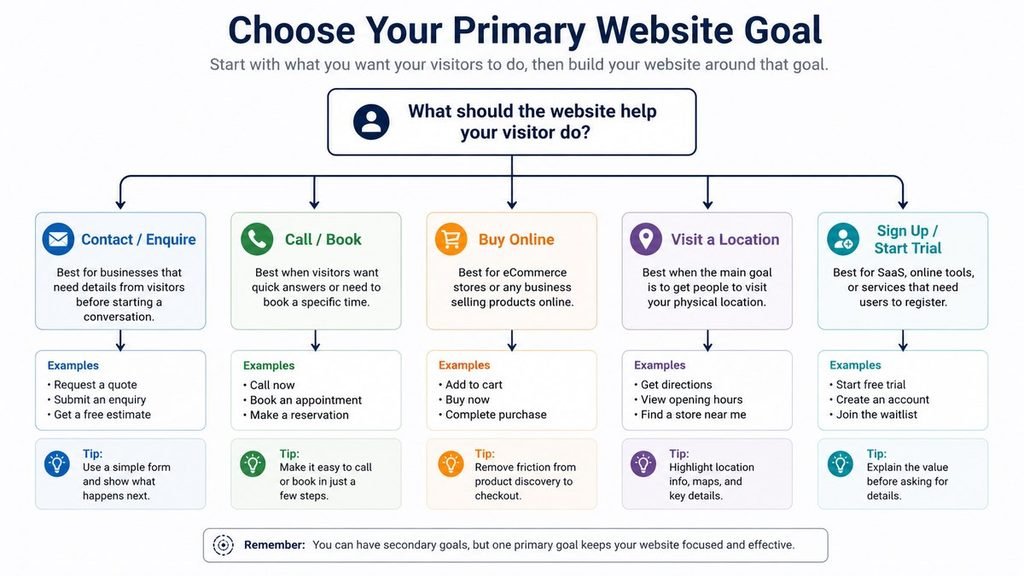
What Is a Primary Website Goal?
A primary website goal is the main outcome you want from a qualified visitor.
For example:
- A plumber may want visitors to call or request an appointment.
- A consultant may want potential clients to submit an enquiry.
- A restaurant may want visitors to make a reservation.
- An online store may want visitors to purchase a product.
- A software company may want visitors to start a trial.
- A local retailer may want visitors to visit the store.
- A nonprofit may want visitors to donate or volunteer.
- A content website may want visitors to subscribe or continue reading.
These businesses can still have secondary goals.
The plumber may also publish helpful articles.
The consultant may also build an email list.
The online store may also encourage account creation.
But those activities should not automatically receive the same visual and strategic priority as the main business objective.
A good primary goal gives you a way to decide what deserves the most attention.
Why One Primary Goal Matters
Imagine visiting a website where the top of the homepage asks you to:
- Request a quote
- Join the newsletter
- Read the blog
- Follow the company on social media
- Download a guide
- Watch a video
- Book a consultation
- Learn about the company
Every action may be legitimate.
But when all eight are presented with similar importance, the visitor has to work out which one actually matters.
That creates unnecessary friction.
Choosing a primary goal helps you establish hierarchy.
It influences:
- The main call to action
- Homepage structure
- Navigation
- Service or product pages
- Forms
- Content priorities
- Trust signals
- Analytics
- Conversion tracking
- Future website improvements
Instead of asking, “What else can we add?”, you can ask:
Does this help the right visitor move toward our primary goal?
That is a much more useful question.
Step 1: Start With the Business Outcome
Do not begin by choosing a button.
Begin with the business result you want.
For example, “Contact Us” is not really a business goal. It is an action.
The result behind that action might be:
- More qualified sales enquiries
- More booked appointments
- More project requests
- More product sales
- More store visits
Start by asking:
What valuable business outcome should this website contribute to?
Common answers include:
Generate Leads
This is common for service businesses, agencies, contractors, consultants, professional services, and B2B companies.
The website’s role is usually to help suitable prospects understand the offer and make contact.
Generate Calls
For urgent or local services, a phone call may be more valuable than a long enquiry form.
Examples might include emergency services, repair businesses, clinics, or businesses where customers want immediate answers.
Book Appointments or Reservations
This may be the primary goal for:
- Salons
- Clinics
- Coaches
- Restaurants
- Tutors
- Service providers
- Consultants
In these cases, the website should remove friction between interest and booking.
Sell Products
For an ecommerce website, completed purchases will usually be the main business outcome.
That affects almost every part of the website, including:
- Product discovery
- Product information
- Trust
- Cart experience
- Checkout
- Payment
- Shipping information
Encourage Physical Visits
A local store, showroom, attraction, or venue may primarily want people to visit in person.
Important website information may therefore include:
- Location
- Opening hours
- Directions
- Parking
- Products or services
- Contact details
Generate Software Signups
For an online product or SaaS business, the primary outcome could be:
- Create an account
- Start a free trial
- Request a demo
- Join a waitlist
Which one is appropriate depends on how the product is sold.
Provide Information or Support
Not every website exists primarily to make an immediate sale.
Some websites are designed mainly to:
- Educate
- Answer customer questions
- Provide documentation
- Reduce support requests
- Distribute resources
The important point is to define the real outcome before deciding how the interface should push visitors toward it.
Step 2: Identify Your Most Important Visitor
A website goal only makes sense when connected to a visitor.
Ask:
Whose action matters most?
Suppose you run a commercial cleaning company.
Your website might attract:
- Existing customers
- Job applicants
- Suppliers
- Small residential customers
- Office managers
- Property managers
- Large commercial prospects
All of them may have legitimate reasons to visit.
But if commercial contracts are the business priority, the website probably should not be designed primarily around job applicants or suppliers.
Your primary website goal should focus on the visitor who matters most to the business outcome you identified in Step 1.
Try completing this sentence:
Our most important website visitor is __________.
Then:
When that person visits, we want them to __________.
For example:
Our most important website visitor is a local homeowner who needs a roof inspection. When that person visits, we want them to request an inspection.
That is already far more useful than simply saying:
We want a professional website.
Step 3: Understand What the Visitor Is Ready to Do
Your preferred business outcome and your visitor’s readiness need to match.
This is important because businesses sometimes ask for too much, too early.
Imagine someone discovering a complex B2B software product for the first time.
The company may want a purchase.
But the visitor may not be ready to buy.
They may first need to:
- Understand the product
- Compare features
- Check whether it integrates with existing systems
- Understand pricing
- Review security information
- See a demonstration
- Discuss requirements
In that situation, Request a Demo may be a more realistic primary website action than Buy Now.
By contrast, someone looking for a nearby restaurant may already be ready to book a table.
Ask:
- How much does the visitor already know?
- How much risk does the decision involve?
- How expensive or complex is the purchase?
- Does the visitor need to speak with someone first?
- Can the transaction reasonably happen online?
- What information must they see before acting?
The best primary goal is usually one that is both valuable to the business and realistic for the visitor.
Step 4: Choose One Primary Visitor Action
Once you understand the desired business result and the visitor’s readiness, turn the goal into one clear action.
Examples include:
- Request a quote
- Schedule an appointment
- Call the business
- Buy a product
- Start a trial
- Request a demo
- Make a reservation
- Visit the store
- Submit an enquiry
- Join a waitlist
Try to make the action specific.
Weak goal:
Get more customers.
Better goal:
Generate qualified enquiries from local homeowners.
Actionable website goal:
Encourage qualified homeowners to request a quote.
The last version is useful because you can actually design around it.
Step 5: Separate Primary and Secondary Goals
Choosing one primary goal does not mean deleting every other useful action.
Instead, create a hierarchy.
For example, a consulting website might use:
Primary goal:
Request a consultation
Secondary goals:
- Read case studies
- Learn about services
- Subscribe to insights
- Read articles
- View the consultant’s background
The secondary actions help visitors move toward the primary goal or serve people who are not ready to act yet.
This distinction is useful because not every visitor will convert during their first visit.
Some people need more information.
Some are researching.
Some will return later.
Your website should support those journeys without losing sight of the main objective.
Step 6: Make Sure the Goal Is Specific Enough to Measure
A useful website goal should be measurable.
Consider this goal:
Build credibility.
Credibility is important, but it is difficult to measure directly.
A better way to think about it is:
Build enough credibility that qualified visitors are comfortable requesting a consultation.
Now the website still needs to build trust, but the final action is measurable.
Depending on the site, useful measurements might include the following. If you use Google Analytics, Google also provides guidance on measuring key events such as lead-form submissions and other important actions.
- Quote requests
- Contact form submissions
- Phone calls
- Appointment bookings
- Reservations
- Completed purchases
- Trial registrations
- Demo requests
- Store direction clicks
- Newsletter subscriptions
You do not need complicated analytics before the website is built.
You simply need to know what successful visitor behavior looks like.
Step 7: Test the Goal Against the Rest of the Website
Once you have a proposed primary goal, test it against your planned website.
Ask the following questions.
Does the Homepage Support It?
If your goal is quote requests, does the homepage explain enough for visitors to decide whether requesting a quote makes sense?
Does the Navigation Support It?
Can visitors easily reach the information they need before taking action?
Do Your Service or Product Pages Support It?
Do those pages answer the questions that could prevent someone from moving forward?
Do Your Trust Signals Support It?
Are reviews, testimonials, case studies, qualifications, guarantees, or other proof shown at the right moments?
Does the Main Call to Action Match It?
If the primary goal is booking an appointment, but your main button says Learn More, the website hierarchy may be too weak.
Can Visitors Complete the Action Easily?
A clear goal does not help if the form is broken, the booking process is confusing, or the checkout is unnecessarily difficult.
Your primary goal should connect the website’s strategy to its actual user experience.
Common Primary Website Goals by Business Type
There is no rule that every business in an industry must use the same goal.
But these examples can provide a useful starting point.
Local Service Business
Possible primary goal:
Request a quote or call
Examples:
- Plumber
- Electrician
- Landscaper
- Cleaning company
- Roofing contractor
Professional Service Business
Possible primary goal:
Submit an enquiry or schedule a consultation
Examples:
- Accountant
- Lawyer
- Consultant
- Architect
- Financial professional
Appointment-Based Business
Possible primary goal:
Book an appointment
Examples:
- Salon
- Clinic
- Therapist
- Tutor
- Personal trainer
Restaurant or Hospitality Business
Possible primary goal:
Make a reservation or visit the location
Ecommerce Business
Possible primary goal:
Purchase a product
SaaS or Online Software
Possible primary goal:
Start a trial, create an account, or request a demo
Portfolio-Based Business
Possible primary goal:
Submit a project enquiry
Examples:
- Photographer
- Designer
- Videographer
- Creative studio
Informational or Content Website
Possible primary goal:
Read more content, subscribe, or return
The correct choice always depends on the actual business model and visitor journey.
What If Your Business Really Has Two Important Goals?
Sometimes two goals genuinely matter.
For example, a restaurant may need both:
- Reservations
- Online orders
A medical practice may need:
- Appointment bookings
- Phone calls
A retailer may want:
- Ecommerce sales
- Store visits
You do not have to artificially eliminate one.
Instead, decide whether one deserves slightly more priority.
You might have:
Primary: Book a table
Secondary: Order online
Or:
Primary: Book an appointment
Secondary: Call the clinic
If both are equally important for different visitor groups, you can present both clearly.
The key is to avoid turning the website into a wall of competing actions.
Two intentional paths are very different from seven unrelated calls to action.
What If Different Pages Have Different Goals?
They often should.
A website has an overall primary goal, but individual pages may have smaller goals that support it.
For example:
Homepage
Goal: Help visitors understand the business and move toward the relevant service.
Service Page
Goal: Help qualified visitors decide whether the service fits their needs.
Case Study
Goal: Build confidence through evidence.
FAQ Page
Goal: Remove uncertainty.
Contact Page
Goal: Complete the enquiry.
Blog Article
Goal: Answer a useful question and guide interested readers toward relevant information.
These page-level goals should work together rather than compete with the website’s overall objective.
Primary Goal vs Call to Action
These two terms are related, but they are not identical.
A website goal is the outcome you want.
A call to action, or CTA, is the interface element that encourages someone to move toward that outcome.
For example:
Website goal:
Generate qualified project enquiries.
CTA:
Request a Quote
Another example:
Website goal:
Increase appointment bookings.
CTA:
Book an Appointment
Thinking about the goal first helps you choose better calls to action later.
Otherwise, websites often end up using vague buttons such as:
- Learn More
- Get Started
- Explore
- Discover
- Click Here
Those phrases are not always wrong, but they may be less useful when a more specific action is available.
Mistakes to Avoid When Choosing a Website Goal
Choosing “Get More Traffic” as the Main Goal
Traffic is usually a means, not the final business outcome.
More visitors only help if the right people arrive and do something valuable.
A better question is:
What should useful traffic eventually lead to?
Making Every Action Primary
If every action uses the same visual weight, there is no real priority.
Copying a Competitor’s CTA
A competitor may have a different sales process, customer type, or business model.
Use competitors for research, not as a substitute for strategy.
Choosing the Business’s Preferred Action Without Considering the Visitor
The business may want an immediate purchase, but the visitor may need more information first.
Using a Goal That Cannot Be Measured
“Look professional” and “increase awareness” can be useful objectives, but they are too vague to guide the entire website on their own.
Never Revisiting the Goal
Your website goal can change as the business changes.
A new business may initially prioritize enquiries.
Later, it may add online booking or ecommerce.
The goal is not permanent simply because you chose it once.
A Simple Framework for Choosing Your Goal
You can make the decision using four questions:
1. Who is the most important visitor?
Be specific.
2. What business outcome matters most?
Think beyond page views and clicks.
3. What action is that visitor realistically ready to take?
Match the action to their level of intent.
4. Can we measure whether they completed it?
If the answer is yes, you probably have a useful primary website goal.
You can combine the answers into one sentence:
Our website should help [visitor] take [action] so that the business can achieve [outcome].
For example:
Our website should help local homeowners request an inspection so that the business can generate qualified roofing leads.
Or:
Our website should help returning customers book appointments online so that the clinic can reduce booking friction.
Or:
Our website should help suitable teams start a software trial so that they can evaluate the product before purchasing.
This sentence does not need to appear publicly.
It is a planning tool.
Use the Goal to Make Better Website Decisions
Once you have chosen the primary goal, keep referring back to it during the project.
When discussing a new section, ask:
Does this help visitors move toward the goal?
When considering another button, ask:
Is this more important than the existing primary action?
When deciding what information belongs on a page, ask:
Does the visitor need this before making the next decision?
When reviewing the finished website, ask:
Can a new visitor tell what to do next?
Your goal becomes a filter for hundreds of smaller design and content decisions.
That is one of the biggest advantages of defining it early.
Final Thoughts
A useful website does not need to force every visitor into one action.
But it should know what outcome matters most.
Start with the business result you want, identify the visitor who matters most, understand what that person is realistically ready to do, and choose one clear action that can be measured.
Then use that goal to guide the site’s content, structure, calls to action, and future improvements.
The result is not necessarily a simpler business.
It is simply a website with a clearer job.
Frequently Asked Questions
Can a website have more than one goal?
Yes. Most business websites have several goals. The purpose of choosing a primary goal is to establish priority, not eliminate every secondary action.
What is the best goal for a small business website?
There is no universal best goal. It depends on the business model. Common goals include generating enquiries, receiving phone calls, booking appointments, selling products, driving store visits, or generating registrations.
Is website traffic a good primary goal?
Usually not by itself. Traffic is useful when it leads to meaningful business outcomes. A better goal connects traffic to actions such as enquiries, purchases, bookings, or subscriptions.
How do I know whether I chose the right website goal?
A strong goal should identify a valuable visitor action, support a real business outcome, match the visitor’s readiness, and be measurable.
Can the primary goal change later?
Yes. Website goals should change when the business model, customer journey, products, or priorities change.
Should every page use the same call to action?
No. Different pages can have different page-level actions. They should simply support the website’s broader primary objective rather than creating unnecessary competition.
Related reading: planning what a small business website should do, planning a small business homepage, and planning a business website from start to launch.